Saturday, July 13, 2013

Hemlocks, Adelgids, Sciences, and Arts

What do these four things have in common?

It began on April 19, when Unity College hosted two amazing women who integrate science and activism in their award-winning poetry.  Alison Hawthorne Deming and Elizabeth Bradfield joined faculty and staff in the afternoon for a discussion of their transdisciplinary work. Everyone was inspired by the overarching questions,"How can the sciences inform the arts?" and "How can the arts inform the sciences?" and "How can scientists and artists bring their attention to the same subject?" and "How can the sciences and the arts come together to create meaningful, accessible communication about environmental crises?" Maybe the first step is for the people to come together. Or maybe the first step is to identify a subject.
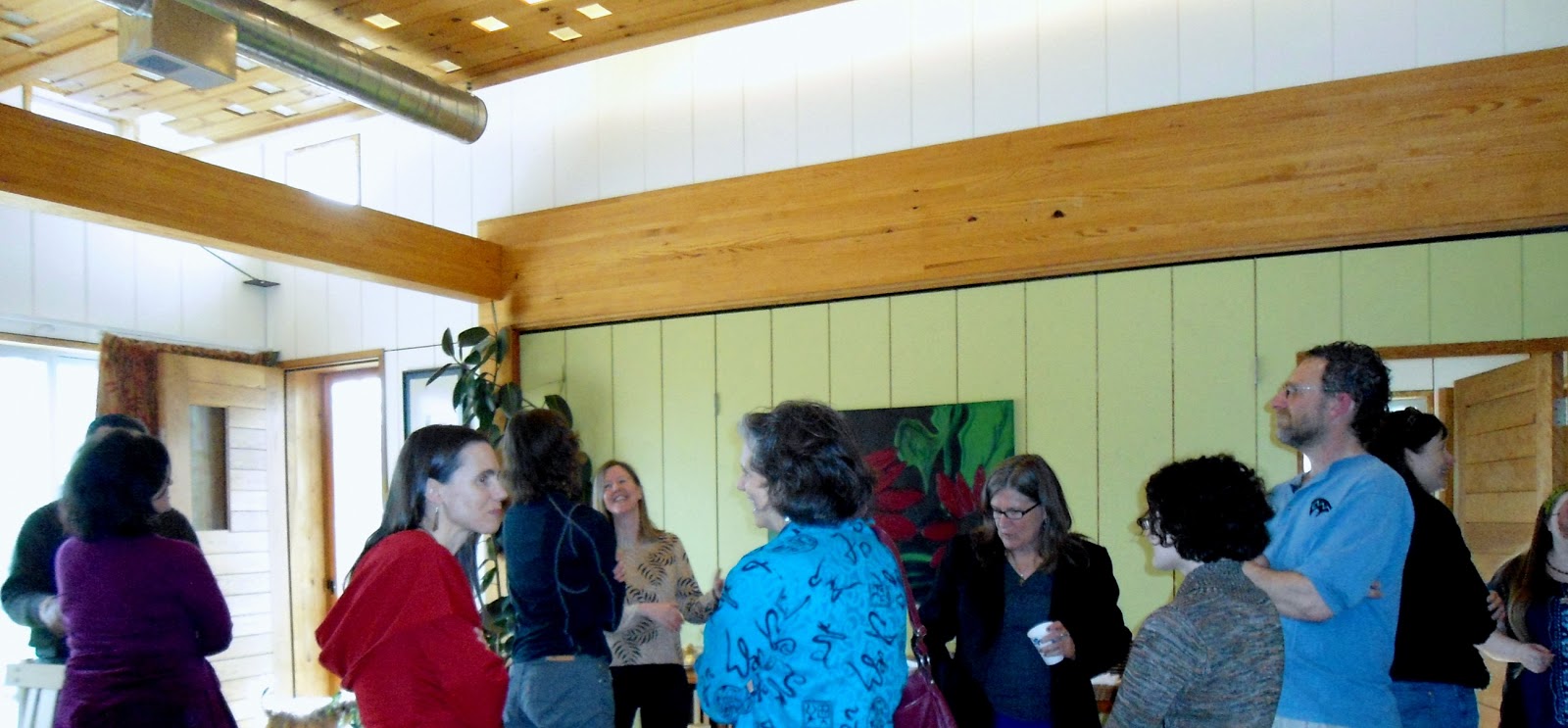

Following the discussion, the poets met with faculty, students, and community arts folks for dinner at Unity House. The space was abuzz with questions about boundaries and meeting places between biology and poetry, and between sciences and arts genrally. We topped off the day with a public reading by Alison and Liz at the Quimby Library that was attended by over 40 listeners. View a video recording (thanks to librarian Sandy Olson) here.


Later in the spring, I got an email about summer research at Unity, including Unity's Hemlock Ecosystem Management Study. Dr. Amy Arnett, the project manager, tells us that "HEMS (the Hemlock Ecosystem Management Study) is a multi-year study of how loss of eastern hemlock trees affects ecosystems and people in Maine. Mature hemlock trees that create unique aesthetic and environmental conditions in the forests they dominate face infestation by the expanding range of the hemlock woolly adelgid (HWA). . . . The range of the invasive HWA is expanding northward; it has arrived in southern Maine."


HEMS, I learned, is already integrated across multiple disciplines. Amy Arnett is an ecologist who specializes in the study of invertebrates, like the ants of the hemlock forest. Brent Bibles is a wildlife biologist who has set up deer exclosures on the sites to study herbivory patterns. Erika Latty's expertise is in forest ecology and plant biology. Kathleen Dunckel brings her knowledge of geospatial information systems (GIS) to the process of land use planning and resource management.

Recalling Alison's description of her observation and writing at a Douglas Fir research site, and Liz's description of how her work in the Arctic inspired her to write about the lives of Arctic and Antarctic explorers raised the questions "Why not hemlocks? and "Why not us?" And now, four people from the arts are meeting with four people from the sciences. Sculptor Kimberly Callas (who took these photos of a HEMS field site), poet/photographer Margot Kelley, writer Melissa Coleman, and poet/multimedia artist Susie O'Keeffe are each approaching our subject -- HEMS -- in unique ways. Stay tuned to see what happens next!


Thursday, April 25, 2013

The Goat Story

On Wednesday, April 24, I came back to Unity House to prepare for a 5 pm alumni meeting. A one hundred fifty pound surprise was waiting for me and the dogs. A large goat stood outside of the sliding glass doors to the living area, and he seemed to be kissing the glass!

Last week, Petey the Goat escaped with a friend during a truck transfer on campus. Public Safety issued an all-points email bulletin for the missing goats, and Petey's friend was soon brought home. But Petey wandered the Unity area (and maybe beyond -- who knows where a goat goes?) for nearly a week.  I had been following the Public Safety updates (essentially, "the goat hasn't been found yet"), so it didn't take long for me to realize that the goat outside the glass was The Missing Goat.

I slid the door open a crack a started gibbering stuff like "Nice goatey," stuck my arm out, and grabbed the goat's leash. As soon as I stepped out onto the brick patio, the goat leapt into the air like a deer.  Thankfully, for me and for him, he leapt into the wire trellis you can see in this photo, and I was able to wrap the leash around the trellis and tie him up.

I called Public Safety, and Kris Miville picked up on the second ring.  Coincidentally, Petey's owner, Julie Kosch, had just been on campus. She and Kris arrived at Unity House in minutes.
Julie, who is adjunct faculty here, was overcome with emotion at the reunion.  Petey had been AWOL for so long, that Julie feared he had become tangled up somewhere, or worse.  I was very touched by her tenderness and concern, and by Petey's affection and obvious relief to be back with her.

And that's the story!

Sunday, February 17, 2013

Ferrets and Hedgehogs and Bugs, Oh My!


In late January, I visited with Assistant Professor Cheryl Frederick in the Koons Hall Small Animal Room.  Cheryl and work study students Patricia Preston, Kristen Volpe, and Kevin Isherwood put zillions of hours into the creation of this room  to create a safe, healthy environment for animals, and all of them continue to work hard to provide day in and day out support to the animals and the facility.  Here, Cheryl is holding one of two African Pygmy Hedgehogs, Daphne and Aspen.  Both Daphne and Aspen were used as breeders for the hedgehog pet industry and are now retired to Unity where they get lots of attention because they are so adorable! The hedgehogs live in a big black tub filled with soil and plants and a few old logs they can hide under.  They are actually quite shy.


The endangered box turtle (above) lives in a similar earthy environment.  He was burrowed into the leaf litter in his terrarium when I arrived, but Cheryl very gently uncovered him so we could get a look at how well his shell colors provide him with camouflage. Sheldon, the Red-Eared Slider turtle, seemed quite gregarious, although I'm not sure he could see me through the glass.  Maybe he was looking for treats.  This turtle is an invasive species in Maine. He transferred to Unity from Avian Haven.

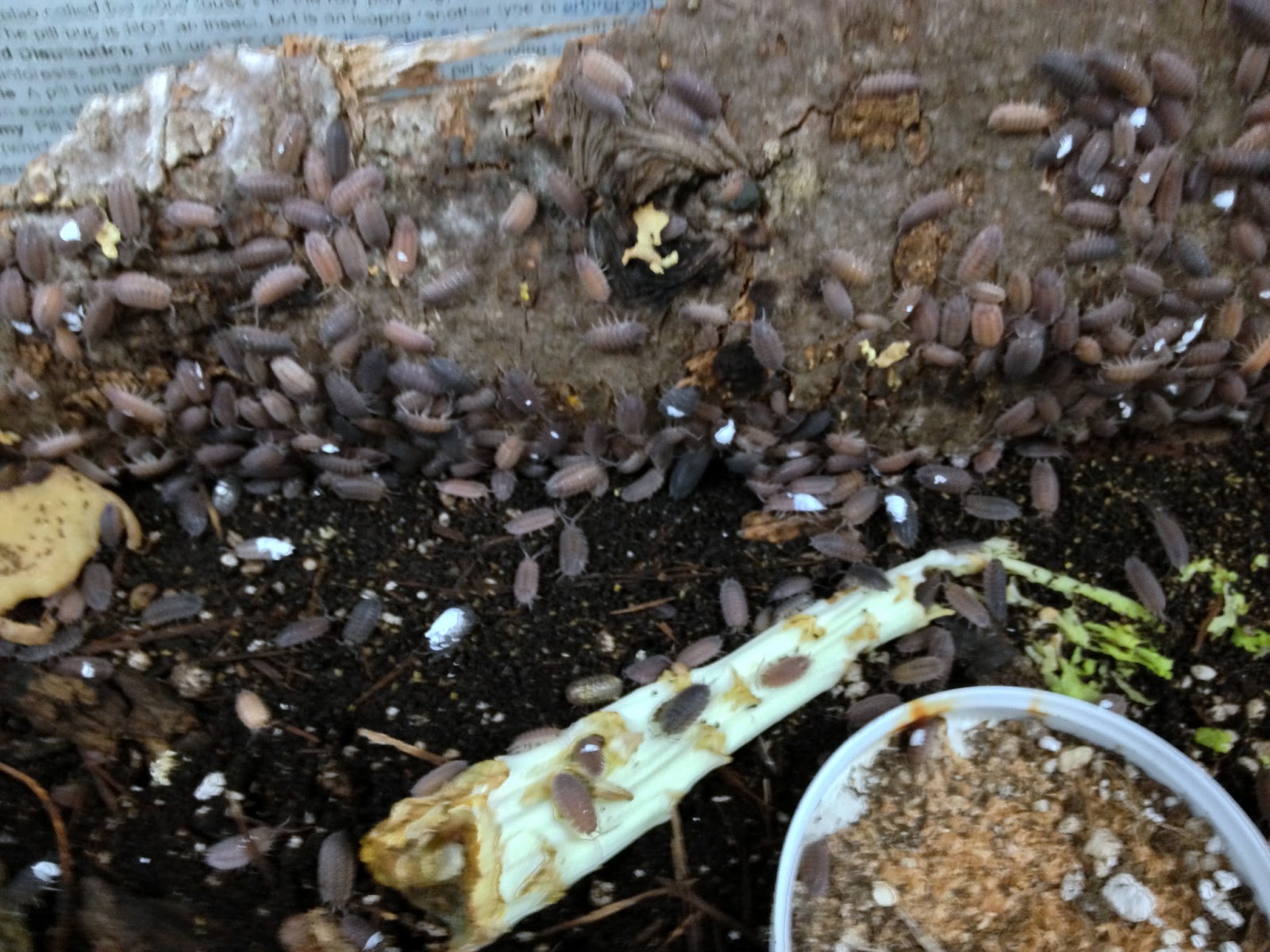
Almost everyone in the room besides me and Cheryl and the work study students eats bugs. So where do all those bugs come from?  To cut down on costs, and to create a sustainable operation, Cheryl and her students raise their own bugs for animal food and as subjects for research and observation.  Here you can see a gang of woodlice that are used in a couple of different classes, and there's also a breeding crate for mealy bugs on top of the refrigerator in case you are hungry. Breeding the mealy bugs right at our facility insures a supply of fresh and wholesome food for the hedgehogs, the turtles, and these Gray Treefrogs, who are native to Maine. One of the frogs was hand-raised from the tadpole stage by Cheryl, and two were found injured on campus by Unity students Sarah Wegner and Skylar Bisesti.
And then there's the ferrets -- four of them -- Bear, Gracie, Raf, and Darnit!  I'm holding Bear in this photo. They smell awful, but they are fun to hold because they just drape themselves into your arms, and they are quite accustomed to human beings.  The four ferrets in the Animal Room were pets that ended up at a ferret rescue home.  The person running the rescue asked Cheryl if she had room, and she said yes!

So far, that's how most of the animals arrived here -- they were either loose invasives, or found on campus, or animals that had been kept as pets or breeders who needed new homes.  All are thriving in the gentle and expert hands of Cheryl, Patricia, Kristen, and Kevin.


Wednesday, January 16, 2013

Stephen and Michele's Winter Break


Stephen and I are back in Unity, getting ready for Professional Development Days and the start of a sparkling new semester. I hope to keep that anything-is-possible feeling right through to the end of the semester.

Like last year, we spent the Winter Break at our old home in Gainesville Florida, where we lived from 2005 to 2008. If you've ever wondered what our trips to the old neighborhood in Florida look like,  check out the slideshow here. And best wishes for a wonderful Spring 2013 semester!

Wednesday, November 7, 2012

Out of the House!

On Monday, November 5th, I drove down to Freeport, Maine with Professor Aimee Phillippi and first year Unity student Ayla Blyther to visit a unique and inspiring learning environment. Coastal Studies for Girls (CSG) is a 16 week semester school for 10th grade girls. 

The day was a blast through the past for Ayla, who was part of CSG's Pioneer Class in the fall of 2011. CSG is the realization of Executive Director Pam Erickson’s decade-long dream to create the nation’s first ever residential science and leadership semester high school for girls. Pam (at right) had a lot of help along the way from generous supporters and other activists, but I think CSG was born largely because Pam had a vision and she never let go of it.
On the ride down, Ayla told me and Aimee about the many connections she sees between CSG and Unity College: the emphasis on science and leadership, the experiential curriculum, but most of all a shared sense of community. As we toured the "little yellow farmhouse" and the recently constructed yurt, I started to understand Ayla's love of CSG, and why that experience led her to choose Unity College.

I roamed around the yurt while Ayla chatted with Vanessa Jones, currently the Extended Programs Coordinator, who was the head resident advisor from 2010 - 2011. Much of the student work had a distinctly Unity-esque feeling about it. I noticed a lot of "we," and a lot of work that demonstrated student ownership of both process and content. Also, the bookshelves were full of familiar favorites.


At dinner (a very delicious dinner), Aimee and I got to talk with the fifteen current students at CSG, and we learned more about the program. We were both struck with how willing all of the girls were to answer questions, to speak up, and to ask their own questions -- must be that leadership piece!


Stephen and I are looking forward to building a sustainable, mutually enhancing relationship between CSG and Unity College. I love my new position as Special Assistant for College Outreach because it's all about making new friends -- and I guess we have to get out of the house to do that!

Wednesday, October 17, 2012

A Sustaining Relationship


On October 11, 2012, Unity House hosted a lunch for representatives from Allen Insurance and Financial and student Shayne Van Leer (pictured at left), the Allen scholarship recipient.

I asked Shayne what he thought about businesses like Allen supporting scholarships at a small college like Unity.  "I'm very thankful as an individual. But I also believe that businesses should be investing in education; it's where their future employees and customers come from.  And, it's a way of giving back to the community."


Conversation ranged over a variety of issues. Richard Crossman (far left) talked about his interest in risk management for renewable energy companies like Revision Energy, the installers of the new solar panels on our library. Dan Wyman (second from left) told us of his experience as an instructor and licensed captain with the Hurricane Island Outward Bound School. We all discovered common connections -- which make for sustaining and sustainable human relationships.


Oh, yes -- and there was dessert!


Sunday, September 16, 2012

Bon Voyage, Joe Galli

 On September 13, Unity House hosted a bon voyage party for Joe Galli, who has served the college in several capacities over the last few years, most recently as the Interim Vice President for College Advancement. Like many Unity folks, Joe made our transition here easier with his friendly, generous personality and his commitment to furthering the mission of the college.


We had two cakes -- an apple cake and a carrot cake in honor of Joe's healthy lifestyle.
 We had serious moments . . .
 and we had silly moments,
new friends,
and old friends,
                                  hugs and more hugs,

 smiling faces,

 and sad faces.
Joe will be missed by faculty, staff, and students. but we all wish him the best in his new Southern California adventure. I will especially miss his sense of humor and his willingness to just be himself.  Stephen will especially miss his insight and wisdom. But the people who will probably miss him most of all are those who worked under him -- Reeta Benedict, Deb Noone, and Cindy Schaub, who valued his way of bringing out the best in people and his understanding of human sustainability.